10.5 T-Test on a Single Population Mean
Suppose that is a population of numbers with (unknown) mean on which a hypothesis test will be done. Using the usual notation, let denote the population standard deviation, and the sample size. If it is known that is normally distributed, then the population of sample means will be normally distributed with mean and standard deviation Thus, as we know already, a -Test can be used in this circumstance, as long as the sample can be assumed to be a simple random sample. But, what if is unknown?
If has a normal distribution, then regardless of sample, the random variable
| (10.5) |
will have a -distribution with degrees of freedom. If we can reasonably assume that the population is normally distributed, we can use Equation (10.5) as the test statistic for a hypothesis test on the unknown mean This test is called the Student’s -Test, or simply -Test.
More precisely, suppose that is one of the three claims or Suppose that a simple random sample of size is selected, giving a sample mean of and sample standard deviation In computing the corresponding -value, is assumed true and is used in Equation (10.5), thus giving the following as the test statistic:
| (10.6) |
From here the -value is computed, just as in the -Test, except one uses a -distribution with instead of using
Remarks: The -Test is fairly robust, if the sample size is not too small. Even with a small sample, if the population is nearly normal and not too skewed, the test will yield reliable results. If the sample size is large, the -Test will yield reliable results, as long as the population distribution is not too pathological. If the sample size is not large, and if it is not reasonable to assume that the sample comes from a nearly normal distribution, then a -Test should not be used. In this case, a nonparametric test should be considered. See Chapter ???.
Example 10.5.1.
A company has committed to purchase an industrial glue if there is strong evidence to support that the mean sealing strength, at a room temperature of 100 F, is greater than 20 lb/ Following are the sealing strengths, measured in lb/ of a sample of 15 tested at 100 F:
At a level of 5%, test whether the company should purchase the glue.
Solution: With a sample of size 15, a -test is appropriate if we can assume that the population of all glue strengths is approximately normally distributed. Unless the sample size is too small, a low-road, yet reasonable approach is to create a frequency histogram of the sample, and qualitatively assess whether it looks like the sample came from a normally distributed population. Figure 10.24 gives such a graph for the sample, using a small number of bins since the sample is small.
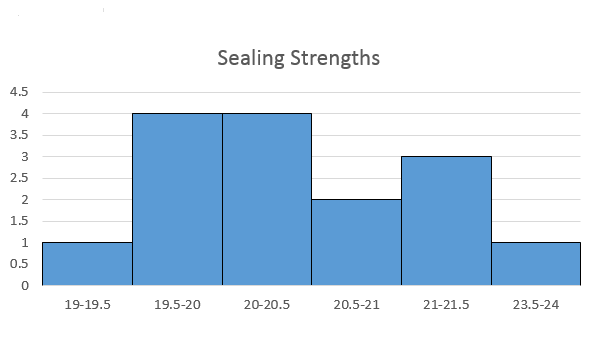
And, indeed, it doesn’t appear unreasonable to assume the sample came from a normally distributed population, i.e., we will use a -test.4545Section 10.9 will provide another qualitative approach on whether the normality assumption is reasonable.
If denotes the mean for the population of sealing strengths of the glue, then the hypotheses are as follows:
Note that the direction of extreme is to the right. From the sample we have and Thus, the test statistic is
The -value is the chance of observing or anything larger, assuming is true, i.e., the -value is
The -value is shown if Figure 10.25.
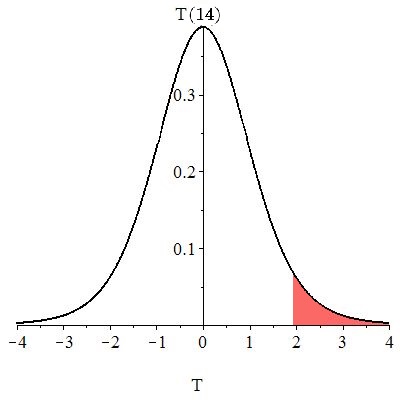
Using the Excel command we can compute the corresponding -value, as shown in Figure 10.26.
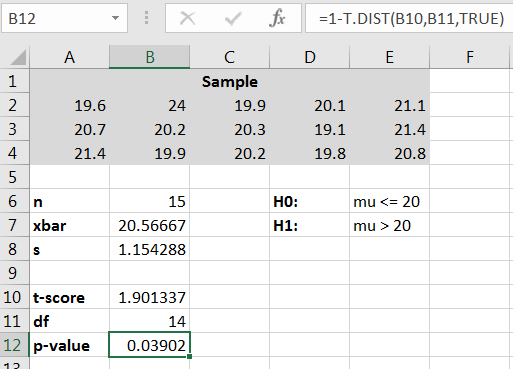
The -value and since we reject There is significant evidence ( ) that the true mean glue strength, at a room temperature of 100 F, is greater than 20 lb/
Example 10.5.2.
Mathematical skills assessment tests were given to a sample first grade children at the end of the school year. Their scores were as follows.
At the 10% level of significance, is there a significant evidence that in the true mean of scores on the mathematical skills assessment exam is less than 60?
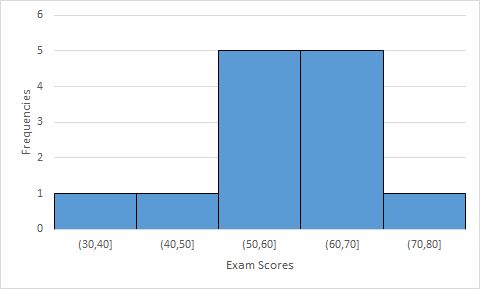
Solution: With a sample of size 13, a -test is appropriate if we can assume that the population of all exam scores is approximately normally distributed. Figure 10.27 gives frequency histogram for the sample, it does appear reasonable to assume the sample came from a normally distributed population.
If denotes the mean for the population of exam scores, then the hypotheses are as follows:
Note that the direction of extreme is to the left. From the sample we have and Thus, the test statistic is
The -value is the chance of observing or anything smaller, assuming is true, i.e., the -value is
The -value is shown if Figure 10.28.
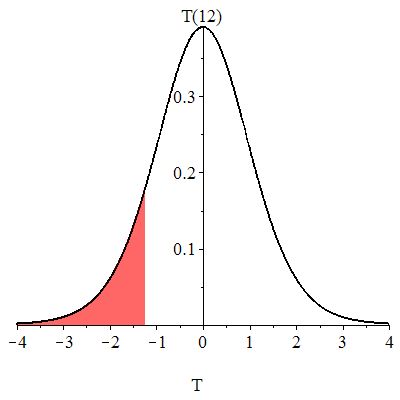
Figure 10.29 illustrates the computation of the -value in Excel.
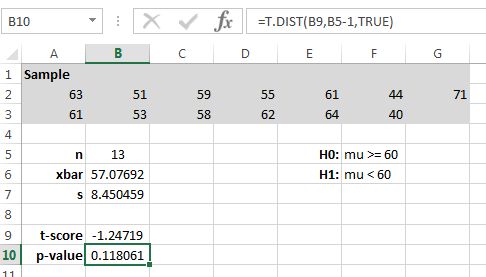
The -value and so we fail to reject There is insufficient evidence ( ) that the mean exam score is less than 60.
Example 10.5.3.
Using the data from Example 10.5.2 on page 10.5.2, but instead use a two-sided direction of extreme, i.e., suppose the hypotheses are:
Compute the corresponding -value.
Solution: The calculation of the test statistic is the same, i.e.,
The -value is the chance of observing or smaller, together with the chance of observing 1.25 or larger, assuming is true. The -value is illustrated in Figure 10.30.
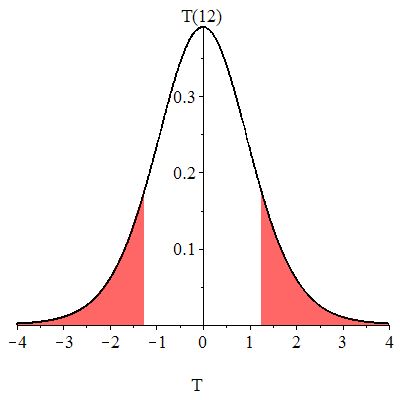
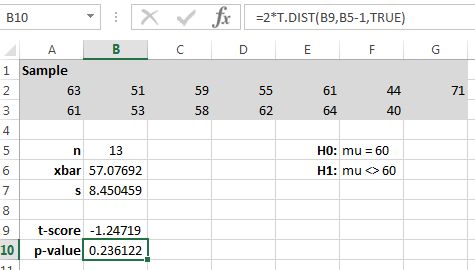
Figure 10.31 shows a method for computing the -value using Excel. Note that the command computes the area of one tale (the area to the left of ), then using the symmetry of the -distribution, the result is multiplied by 2.
Exercises
-
1.
Since 1982, the United States penny is claimed to have average weight 2.5 grams. A sample of 15 pennies were selected, yielding the following wights (in grams):
At the 10% level, does the sample provide strong evidence that the mean weight of pennies is not 2.5 grams?
-
(a)
What is the population of interest?
-
(b)
State the competing hypotheses.
-
(c)
What is the direction of extreme?
-
(d)
Why is it reasonable to use a -Test?
-
(e)
Compute the test statistic and corresponding -value.
-
(f)
Sketch the -value.
-
(g)
State your conclusion, i.e., do you reject or fail to reject
-
(h)
State the conclusion in a manner appropriate for a scientific journal.
-
(i)
What type of error could have been made?
-
(a)
-
2.
Nationwide, the average weight of newborns is approximately 7.5 lbs, but a city health official is concerned that the average birth weight in her city is less. Using recent local hospital records, she obtained the following sample of newborn weights (in lbs):
At the 5% level, does the sample provide strong evidence that the mean weight of newborns in the city is less than 7.5 lbs?
-
(a)
What is the population of interest?
-
(b)
State the competing hypotheses.
-
(c)
What is the direction of extreme?
-
(d)
Why is it reasonable to use a -Test?
-
(e)
Compute the test statistic and corresponding -value.
-
(f)
Sketch the -value.
-
(g)
State your conclusion, i.e., do you reject or fail to reject
-
(h)
State the conclusion in a manner appropriate for a scientific journal.
-
(i)
What type of error could have been made?
-
(a)
-
3.
A common estimate for the average length of a song played on the radio is 3 minutes and 30 seconds. Rita believes that the average length of songs on her IPOD is longer, but she doesn’t have the time to do a census of all 15896 songs. Instead she takes a sample, with the results given below (in seconds):
At the 10% level, does the sample provide strong evidence that the mean length of songs on Rita’s IPOD is greater than 3 minutes and 30 seconds?
-
(a)
What is the population of interest?
-
(b)
State the competing hypotheses.
-
(c)
What is the direction of extreme?
-
(d)
Why is it reasonable to use a -Test?
-
(e)
Compute the test statistic and corresponding -value.
-
(f)
Sketch the -value.
-
(g)
State your conclusion, i.e., do you reject or fail to reject
-
(h)
State the conclusion in a manner appropriate for a scientific journal.
-
(i)
What type of error could have been made?
-
(a)