9.4 Direction of Extreme - Two Sided
Example: Suppose that two populations of numbers are as follows: Population 1 contains one -3, two -2s, three -1s, four 0s, three 1s, two 2s, and one 3; Population 2 contains four -3s, three -2s, two -1s, one 0, two 1s, three 2s, and four 3s. Figure 9.8 illustrates.
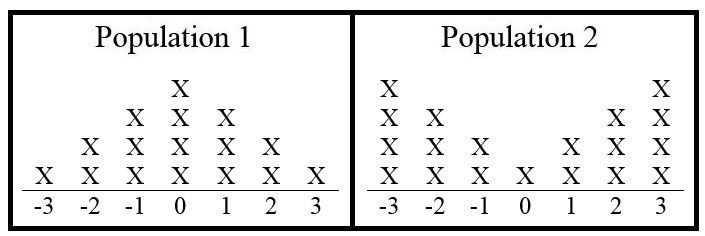
Suppose a box is chosen, and a number from the box is chosen at random. The hypotheses for this test are:
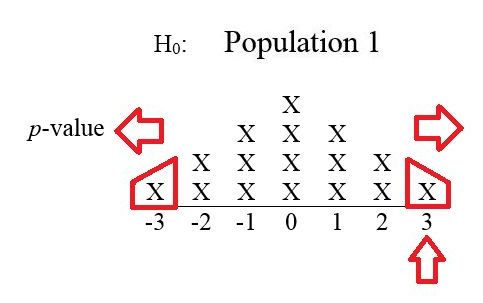
Note that stronger evidence against are values that are large or values that are small. In this case we call the direction of extreme two sided. For example, 3 and -3 give the same level of evidence against If a 3 is the selected number, then the corresponding -value is because there are a total of 16 numbers in Box 1 (remember that is assumed true), and 3 and -3 are the only numbers at or more extreme than the selected 3. Figure 9.9 illustrates.
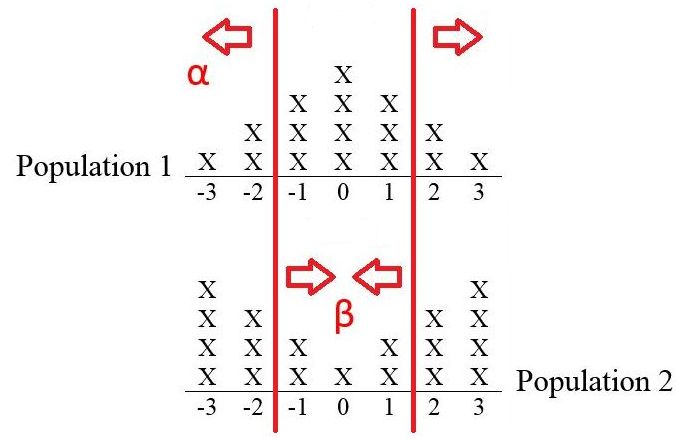
Similarly, computations for and are done using symmetry as well. For example, if the decision rule is “reject if the observed number is or more extreme,” then and Figure 9.10 illustrates.
Concepts Check:
-
1.
Suppose that the selected voucher is 1. What is the corresponding -value?
Answer: -
2.
Suppose that the decision rule is “reject if the selected number is or more extreme.” What is the value of
Answer: -
3.
Suppose that the decision rule is “reject if the selected number is or more extreme.” What is the value of
Answer: