7.3 Continuous Random Variables
If the random variable is continuous, then probabilities for observed values of are described differently than the discrete case. In the continuous case, is accompanied by a probability density function (p.d.f.) To be a proper p.d.f., the function must satisfy the following:2828Equation 7.4 uses calculus. If you’ve not had calculus, ignore the symbols, and focus on the verbal description.
-
•
For all
-
•
For any and with the probability that a randomly generated is between and is the area under the graph of i.e.,
(7.4) -
•
The total area under the graph of is 1, that is,
Notes:
-
•
Figure 7.6 gives a graphical representation of
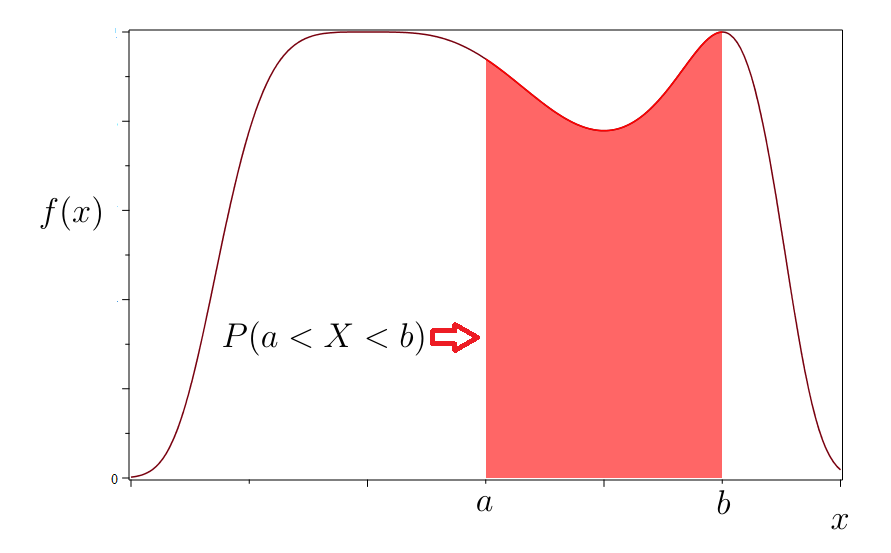
Figure 7.6: Area Under Curve as -
•
For any real number because the area of a line segment is 0. This may seem odd, but it’s the nature of the beast. It follows as well that