10.7 Confidence Intervals and Two-Sided Hypothesis Tests
A two-sided test on a population mean can be conducted using a confidence interval for We’ll use a -Test to illustrate.
Suppose that the null hypothesis is and suppose that the significance level for the test is Recall that the rejection region for a hypothesis test is the collection of values for the test statistic in which the null hypothesis is rejected. Let denote the critical value, i.e., the value that bounds the critical region as shown in Figure 10.38.
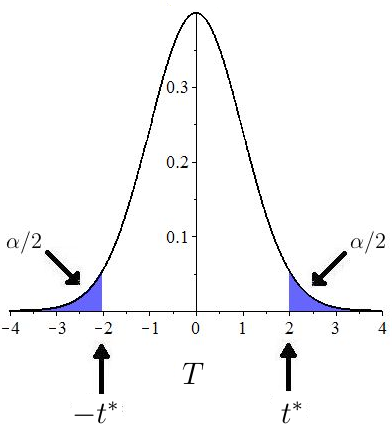
The critical value, , is the same value of used in constructing a confidence interval,
where and are summary statistics for a sample. Now the test statistic for the sample is
and is not rejected if This is equivalent to not rejecting if is in confidence interval, i.e.,
The upshot, then, is that the null hypothesis is rejected precisely when the value does not land in the confidence interval.
Two examples will illustrate.
Example 10.7.1.
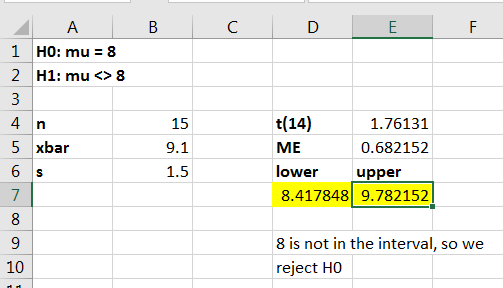
Suppose that is to be tested at the 10% level. Suppose that a simple random sample yields the summary statistics and assume that it is reasonable to assume that the sample came from a normally distributed population.
Now is chosen so that we are 90% confident that the true mean is in the confidence interval. Since we want the area to the left of under the curve to be 0.95. So,
The margin of error for the confidence interval is
and so the 90% confidence interval is or in interval notation Since the interval does not contain we reject i.e., there is significant evidence against
The calculation is shown in Figure 10.39.
Example 10.7.2.
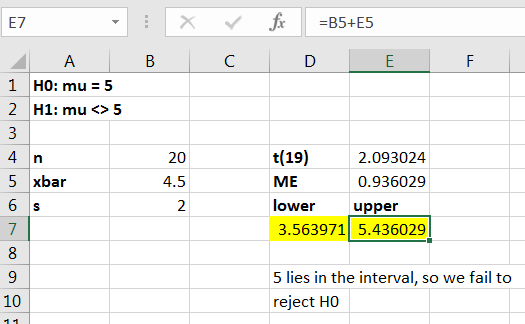
Suppose that is to be tested at the 5% level. Suppose that a simple random sample yields the summary statistics and assume that it is reasonable to assume that the sample came from a normally distributed population.
Now is chosen so that we are 95% confident that the true mean is in the interval. Since we want the area to the left of under the curve to be 0.975. So,
The margin of error for the confidence interval is
and so the 95% confidence interval is or in interval notation Since the interval does contain we would fail to reject i.e., there is insufficient evidence against
The calculation is shown in Figure 10.40.
10.7.1 Exercises
-
1.
At a significance level of 5%, a hypothesis test is to be done on A simple random sample of size 22 is taken, and a sample mean of 13.3 and sample standard deviation of 2.5 are found. Use a -Interval to make the decision.
-
2.
At a significance level of 10%, a hypothesis test is to be done on A simple random sample of size 19 is taken, and a sample mean of 31.0 and sample standard deviation of 3.1 are found. Use a -Interval to make the decision.