Chapter 1 What is Computational Science?
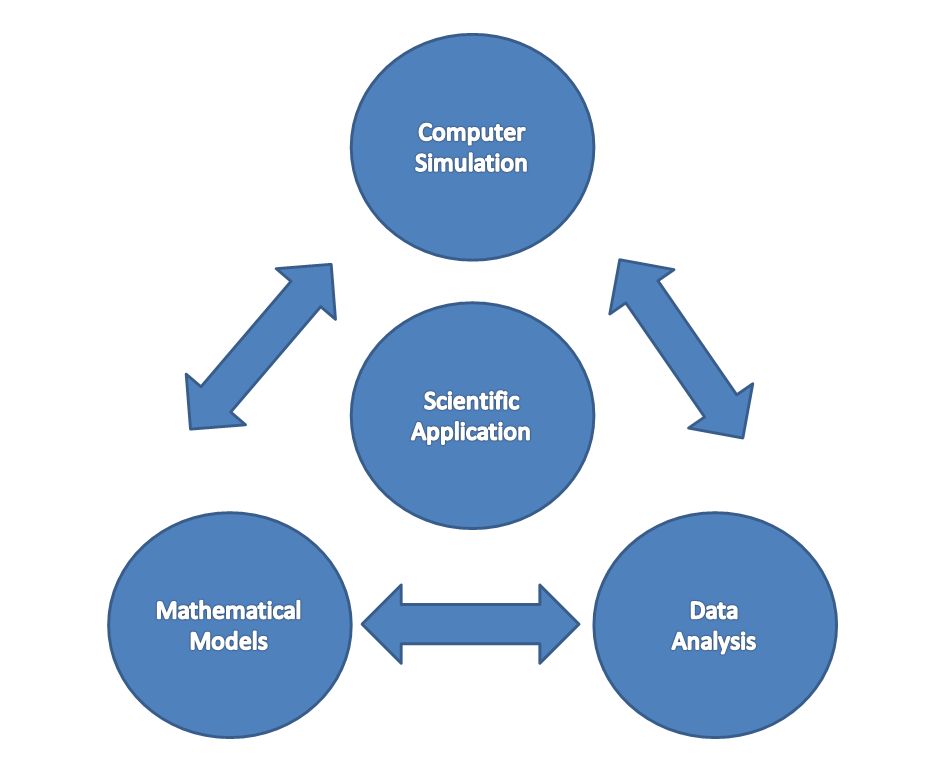
Computational Science is an interdisciplinary field that seeks to simulate real-world phenomena. A simulation involves using mathematical models and computer models to generate data, which is then analyzed to assess the models, to make predictions, or to estimate. With recent advances in computational power and applied mathematics, Computational Science has become an integral part in doing modern science. For example, in computational pharmacology, simulations are run to test new drugs before using live specimens, providing for the development of better drugs at faster rates and lower cost. In short, Computational Science is a three-legged stool (see Figure 1.1 on Page 1.1), with the legs being mathematical models, computer simulation, and data analysis, combining to do applications in science.
Computational Science is used to study animal behavior, climate change, traffic patterns, spreading of disease, space travel, cosmological evolution, social change, economics, and politics. There are emerging new areas of research with names like computational biology, computational sociology, computational finance, computational linguistics (seriously), computational neuroscience, and scientific visualization. Do an online search on computational science and you will get an overwhelming list of examples and images to explore.
Usually, a computational science textbook will assume or develop calculus and programming skills. This book won’t. Instead, this book will build computational skills needed for analyzing data. Using simulations to study how data and data summaries behave, this book attempts to build intuition for statistics without using calculus. In a sense, this text is similar to a standard algebra-based introductory statistics book, except greater reliance is made on simulations, probability theory is de-emphasized, and computer skills are integrated throughout.